a skipper with a licence or a trained skipper?
Nearly all discussions with future skippers start the same way: „I want the licence. How long does it take, how much does it cost, when's the next session?” The correct question is different: „Am I prepared to be assessed for five consecutive days, on a boat, in real conditions?”
Because that's exactly what RYA Day Skipper is.
The RYA exam lasts five days
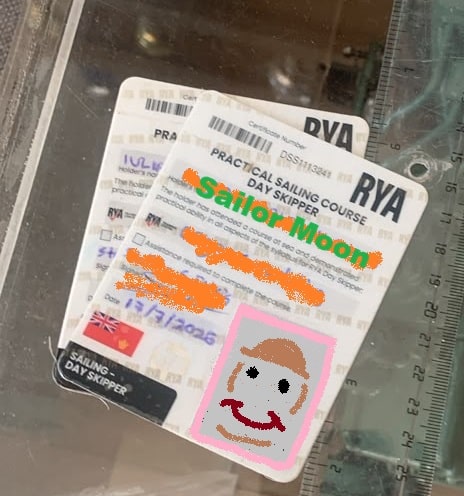
The RYA Day Skipper course doesn't end with a multiple-choice test and a handshake. The instructor is also the examiner. For five days, they watch your every manoeuvre, every decision, and how you coordinate your crew. At the end, you only receive the Day Skipper certification if you have consistently demonstrated the required standard; otherwise, you go home with Competent Crew.
This completely changes the perspective: you can't „cram” for such an exam, you can't hope for easy topics, and the only way to pass it is to already know how to navigate.
What does the RYA assume you already know
Few people read this part of the RYA syllabus: Day Skipper Practical is not a course for absolute beginners. The RYA recommends prior sea experience before the course – 5 days of sailing, around 100 miles covered, and a few hours of night sailing, plus Competent Crew level basics.
In other words, the licensing course starts from the premise that you are no stranger to a boat. Over the five days, what you bring from home is polished and assessed; it's not built from scratch.
Realistically speaking
From our over 15 years of experience, with hundreds of students who have completed RYA courses, the figures are simple: out of a group of five students attending Day Skipper with no prior experience, at most one, possibly two, go home with the certification – and even then, just about. The rest receive Competent Crew and an invitation to return after they have gained experience. The chances of passing comfortably, without any stress, are practically non-existent. nil.
Not because the instructors are bad or the examination unfair, but because five days simply isn't enough time to learn manoeuvring, navigation, meteorology, traffic rules, and crew management from scratch, to the level you are continuously assessed at.
A typical example, which we see every season: an enthusiastic student, having read the theory twice and with YouTube tutorials at their fingertips, confidently gets on the boat on Sunday evening, and on Monday morning, at the first docking with a crosswind in a crowded marina, the entire plan in their head evaporates. The rest of the week is spent trying to catch up, tired and frustrated, while their colleague who has been through HOP performs the same manoeuvres calmly, on who knows how many repetitions. They are both attending the same course, yet only one is using it to perfect their skills.
Those who come with a solid week of practice behind them enter the course relaxed. The manoeuvres are familiar to them, as is the vocabulary, and Energy goes into refining, not survival..
On the ICC route? The same logic, just more compressed.
Perhaps you're not aiming for the RYA, but for the Romanian category C licence, with the corresponding ICC. Let's do the same calculation there: typical practical training means two days on a boat, shared with seven other students. Eight people, two days – the time you, personally, spend at the helm and executing manoeuvres is realistically measured in minutes, not hours.
And what about the progression to category A, B? It doesn't depend on the miles covered or the experience gained, but on the age of your licence. You can spend two years on the sofa watching sailing videos on YouTube (in the happy event that you even watch sailing) and the system will consider you ready for more. The system doesn't ask how much you've sailed or what experience you've gained. Everyone just asks how long you've had your licence.
It's just that the sea doesn't check the issue date. And neither does the charter company, when they ask for your sailing CV, they don't look at how old the paper is, but at your actual miles and weeks on the boat. The conclusion is the same, regardless of the licensing route chosen: the paper remains a formality. Practice remains the necessity.
Here comes HOP
Hands-On Practice is exactly the piece missing from the equation. Seven days on a sailing yacht, a maximum of 5 trainees, a minimum of 8 hours of practice per day, in marinas and real traffic conditions in Greece. You'll go through everything that matters: mooring manoeuvres in all variations (med-mooring, bow-in, stern-in), anchoring, mooring buoys, MOB, safety procedures, full boat check-in, crew briefing, night navigation.
Meaning, even more so than the luggage that RYA presumes when you step onto the exam boat. It's no coincidence that many of our students follow the same route: HOP first, then RYA Day Skipper. And the difference is apparent from the first day of the course.
You already have the licence – RYA or ICC? Read on.
You might have obtained the certification a year, two, or five years ago. Congratulations, honestly – but let's be just as honest about what it actually means.
The Day Skipper certificate qualifies you for coastal sailing, mainly during daylight hours, in familiar conditions. That’s it. It doesn’t certify you for the crowded marina in Lefkada in the middle of August, for the 46-foot boat the charter company gives you instead of the 40-foot one you trained on, leaving a substantial deposit based on non-existent practical experience, for a crew of friends who’ve never laid a hand on a rope, or for the meltemi that kicks in just when you’re about to moor. And if you hold an ICC, you’ve seen above just how much practical experience your licence is based on – we won’t dwell on it any further.
And there's something else: manoeuvring skills are perishable. If after a course you've only sailed one or two weeks a year, or not at all, that sure hand on the helm isn't quite so sure anymore. You feel it immediately when docking – and your crew feels it too.
A licence in your wallet doesn't degrade, skills do. That's why HOP isn't just for those preparing for their licence, but also for those who already have it and want to be the skippers their crew can truly rely on: a whole week of repeating manoeuvres until they become second nature, in real charter conditions, with a trainer beside you correcting precisely the habits you've picked up in the meantime.
The correct order
The licence is important – without it we can't hire a charter boat. Obtaining the licence is the natural consequence of preparation, not the goal itself. When you come with your practice done, certification becomes what it should be: a formality that confirms what you already know.
So, if you're planning for next season, do it in the right order:
- HOP – Hands On Practice – 7 days of intensive practice, your real foundation.
- RYA Day Skipper – 5 days in which you confirm what you know and leave with an internationally recognised licence.
And if you've had your licence for a while, the process is even simpler: get back to practising. A week of HOP face the difference between a Skipper with a licence and a qualified skipper.
See you at sea!
Yours, Perju